Field-validated · in production
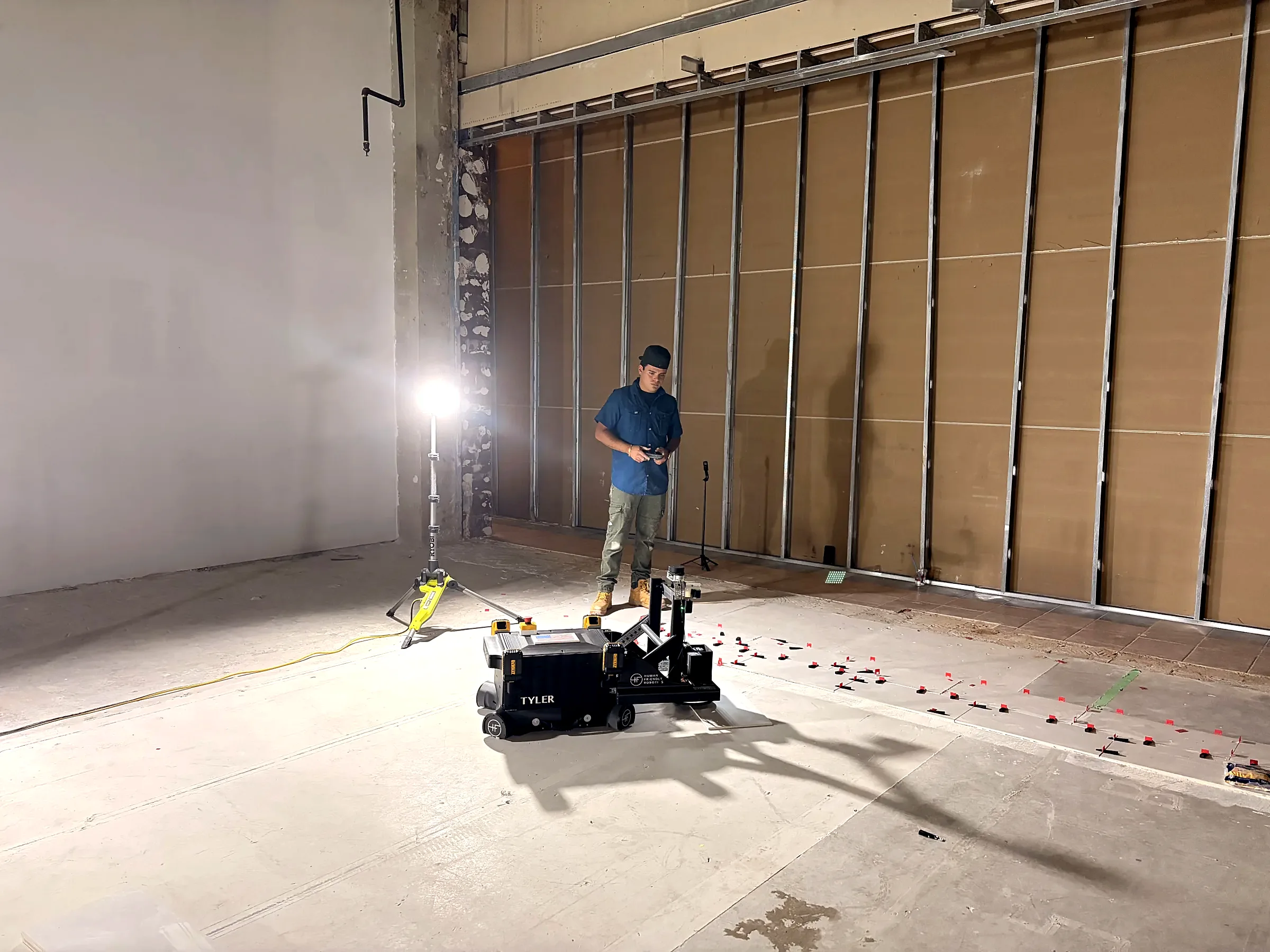
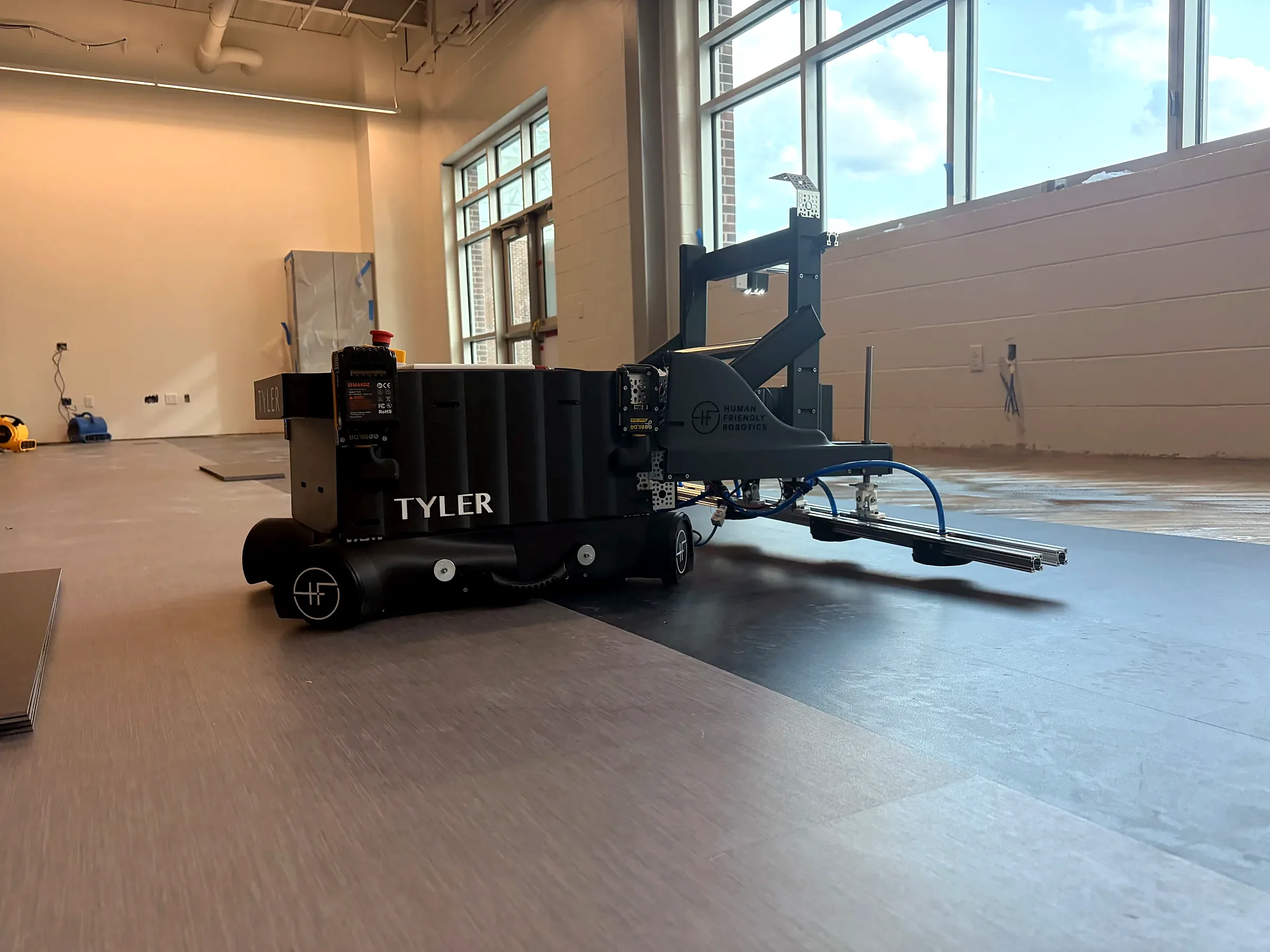
Tyler lays the floor. The trade can't hire fast enough.
A 50-lb flooring robot that installs ceramic tile, LVT, VCT, and carpet tile. One operator delivers 800 sq ft/day in ceramic or 1,500 sq ft/day in glue-down LVT.

The spec sheet
Built to a number,
About 100 sq ft an hour in ceramic placement, with ±1 mm precision and one operator alongside Tyler. Your crew handles preparation, cuts, edges, and finishing.
Performance
Hardware
Operations

Savings calculator
What would your next floor cost with Tyler on the crew?
Enter your own crew numbers. Compare your crew working alone with a smaller crew working alongside Tyler, and see the time and labor you could save on one job.
Side by side
| Crew only | Crew + Tyler | |
|---|---|---|
| Installers | 3 | 2 |
| Sq ft per day | 600 | 1,300 |
| Workdays to finish | 33.3 | 15.4 |
| Crew-hours | 800 | 246 |
| Crew labor | $100,000 | $30,769 |
| Tyler (13,846 sq ft placed) | — | $6,923 |
| Total installed cost | $100,000 | $37,692 |
| Cost per sq ft | $5.00 | $1.88 |
Schedule
Each tile is one workday.
On your own, a crew of 3 laying 600 sq ft a day needs 33.3 workdays to finish 20,000 sq ft of porcelain or ceramic. At $125 an hour, that's $100,000 in labor, or $5.00 per sq ft.
With Tyler setting the full tiles, 2 installers and Tyler together put down about 1,300 sq ft a day, so the job wraps in 15.4 workdays. Each installer covers 3.3× as much floor per day.
Your crew labor drops to $30,769, plus $6,923 for Tyler. That's $37,692 all in, saving $62,308 (62%), and your crew is free 17.9 days earlier to start the next job.
These figures are planning estimates based on the numbers you enter. Actual results depend on site conditions, layout, tile size and how much of the floor is full tile versus cuts. Assumes 8-hour shifts, with Tyler placing 900 sq ft per 8-hour shift on porcelain and ceramic, 1,600 sq ft on glue-down tile, at $0.50 per sq ft placed. Final Tyler pricing is quoted per project. Mobilization and travel are not included.
Toward physical compute
Tyler is the first worker.
Flooring gives us a concrete place to prove machine labor: a defined scope, measurable output, and work a contractor can inspect. It is the first step toward physical compute, where physical labor becomes reliable infrastructure.
Explore the larger idea →